


2021 Honda Civic Vs Toyota Corolla
In the compact car market, the 2021 Honda Civic and Toyota Corolla are two options well worth considering. With strong handling, good acceleration, and a comfortable interior, these two cars are ideal for city driving or for a small family. Here’s how the Civic stacks up against the Corolla.
Engine and Performance
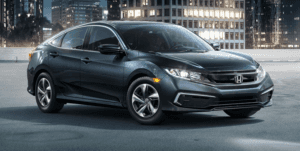
The 2021 Civic offers three engine options for you to choose from. The base offering is a 2.0-liter V-4 capable of putting out 158 horsepower. While this is more than adequate for day-to-day driving, you may prefer to step up to the 1.5-liter turbocharged V-4 that puts out 174 horsepower. If you’re into top-notch performance, there’s also a 2.0-liter turbocharged engine that cranks out an impressive 306 horsepower. A continuous variable transmission is available throughout the Civic’s lineup, but you can also opt for a six-speed manual transmission.
Even with its outstanding power, the Civic achieves good gas mileage. The base engine in the sedan manages 32 mpg in the city and 42 mpg on the highway.
The Corolla can’t quite match the Civic’s power. Its base 1.8-liter four-cylinder engine churns out 139 horsepower. The stronger 2.0-liter V-4 with its 169 horsepower gives you slightly more under the hood than the Civic’s base engine, but still less power than Honda’s turbocharged offering.
The Corolla is just about as good as the Civic when it comes to gas mileage. The hatchback can manage up to 32 mpg on city roads and 41 mpg on the highway.
The Civic stands out due to its ride handling and performance. It’s one of the few compact cars with an independent rear suspension, which helps improve ride quality. Its more powerful engine also gives it a more rapid acceleration than the Corolla. The Civic can shift from 0 to 60 mph in just 7.8 seconds, while the Corolla requires 10.2 seconds.
Seating and Cargo
In the Corolla sedan, you’ll find just over 13 cubic feet of cargo space behind the rear row of seats. That increases to 17.8 cubic feet in the hatchback. Both the sedan and hatchback have folding rear seats to open up more room to carry larger items.
When it comes to seating, there’s room for five passengers. The front seats are roomy, but the rear row may be better suited for shorter passengers due to the limited legroom and headroom.
The Civic offers more cargo space than the Corolla. In the sedan, you’ll find 15.2 cubic feet behind the rear row, while the hatchback offers a spacious 25.7 cubic feet with the rear row up. Fold-down the hatchback’s second row of seats and you’ll gain access to over 46 cubic feet of cargo capacity.
In terms of seating, the Civic’s two rows provide ample legroom for five passengers. The rear legroom in the Civic is over 37 inches, which compares favorably with the Corolla at 34.8 inches. There are also two complete sets of LATCH connectors for the rear outer seats in case you need to install child seats.
Infotainment and Technology
The Civic’s standard infotainment system features a 5-inch display, four speakers, a USB port, and Bluetooth connectivity. If you plan on linking your phone to your Civic’s infotainment system, you may want to upgrade to get access to Apple CarPlay and Android Auto. The improved entertainment setup also features a 7-inch touch screen.
Unlike Civic drivers, Corolla owners benefit from Apple CarPlay and Android Auto as standard infotainment features. They also get a 7-inch touch screen, a wireless hot spot, and two USB ports in the base setup. You can upgrade to an 8-inch screen, wireless device charging, and an HD radio.
Driver Assistance
Both of these compact cars are well equipped with safety features to support you behind the wheel. These include forward-collision warning, which provides audio and visual warnings if a vehicle or other object is detected up ahead, and automatic emergency braking, which applies your brakes to avoid a collision.
There are also specific assistance technologies for highway driving. These include lane departure warning and lane keep assist, which helps you stay in the correct lane. Adaptive cruise control can adjust your speed to help you maintain a safe distance from the drivers in front of you.
Trims
Before you choose a Civic trim, you first need to decide on your preferred body style. The sedan is good if you want to stay compact, while the hatchback gives you a little more room for cargo. The sedan is available in five trims: LX, Sport, EX, EX-L, and Touring. The hatchback has four trims: LX, Sport, EX, and Sport Touring.
Stepping up to the Sport trim gets you access to the upgraded infotainment system and a leather-wrapped steering wheel. The range-topping Touring and Sport Touring trims feature power-adjustable front seats, heated front, and rear outward seats, and a premium audio system.
The Corolla sedan can be purchased in five trims: L, LE, SE, XLE, and XSE. If you opt for the hatchback, there are two trims to choose from SE and XSE.
The SE trim features a larger engine, front sports seats, and alloy wheels. You can also replace the continuous variable transmission with manual transmission for an additional $700. The range-topping XSE gets leather upholstery, heated front seats, and proximity keyless entry.
We hope that our comparison of the 2021 Honda Civic and Toyota Corolla has helped you decide which of these compact cars is right for you. If you’re looking for power under the hood, plenty of cargo space, and class-leading gas mileage, the Civic is your best choice. As the MotorTrend website put it, “It’s simply the best compact sedan you can buy today.”
Here at Performance Kings Honda, we’re proud to assist customers like you to select the right vehicle to meet your needs, whether it’s a Civic or another model from Honda’s impressive 2021 lineup. If you have any questions about the Civic or you’d like to get the buying process started, don’t hesitate to contact us today. Give us a call at (513) 793-7777.
0 comment(s) so far on 2021 Honda Civic Vs Toyota Corolla