


Honda Dashboard Warning Lights (Complete Guide)
Your car warning lights alert you to problems before they become serious. However, a recent study from insurance marketplace The Zebra found that many Americans don’t know what the most common warning lights mean. The study found that 30% can’t identify the tire pressure warning light, 40% don’t recognize the coolant temperature warning light, and a whopping 73% don’t know their oil pressure warning light. How do you fare? In this guide, we at Performance Kings Honda explain what the most important dashboard warning lights look like in your Honda, so you can stay on top of your car’s condition.
Tire Pressure Warning Light
The amber tire pressure warning light looks like the cross-section of a tire with an exclamation point in the center. When you switch the ignition on, you can expect it to light up for a few seconds. If it stays on, one or more of your tires may have low pressure. Depending on your model, you may also see a message indicating which ones may have low pressure.
You can still drive your car with this light on, but you should be careful since low pressure can impact your car’s steering and braking. Aim to visit your nearest gas station to increase their pressure in line with the specifications in your owner’s manual. If adding more air doesn’t solve the problem, you may have a puncture. A mechanic can tell you whether they can repair your tire or recommend replacing it.
Coolant Temperature Warning Light
Sometimes called the engine temperature warning light, this is usually a red light that looks like a thermometer in water. The coolant or engine may be running hot if it flashes while driving. Drive slowly and steadily to the garage to avoid overworking your engine. A light that stays on suggests your engine is overheating, so pull over as soon as it’s safe. If steam isn’t coming from your motor and your cooling fan is running normally, try topping up your coolant. If this doesn’t solve the problem or something seems more serious, get your car towed to a mechanic.
In some Honda vehicles, this light may also glow blue when the engine coolant is too cold. Usually, it will resolve itself once you’ve run the engine for a while. But if the blue light stays on, your sensors could have a problem that requires service.
Oil Pressure Warning Light
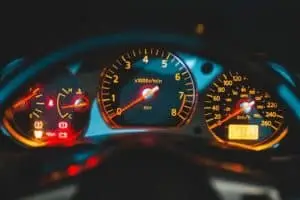
Photo by Erik Mclean from Pexels is licensed with CC BY 2.0
The oil pressure warning light is the red light that looks like an old-fashioned oil can. Depending on your model, it may also have a wavy line underneath. It should illuminate when you switch your Honda’s ignition on and turn off when the engine starts. If the light comes on when the engine is running, this could be a problem. If it flashes, your oil pressure may have dropped temporarily before recovering, and if the light stays on, it means your oil pressure is consistently low — both are problems that require immediate attention.
Many people misidentify this light as a warning of low oil level rather than low oil pressure. The two problems are often linked, but this light may come on even if sufficient oil is in the reservoir. Worn engine bearings, a clogged oil filter, and malfunctioning oil pumps or pressure relief valves can all cause low oil pressure. Low pressure prevents the oil from flowing freely to lubricate all your engine’s moving parts. This can cause friction and serious damage if left untreated. Book a service immediately if the light stays on after topping up your oil.
Engine Management Warning Light
The engine management warning light is an amber light that looks like an engine block. Unlike most other Honda warning lights, it doesn’t alert you to a specific fault. Instead, it’s a more general sign that your engine isn’t working correctly. Usually, you’ll notice other signs of engine problems as well, such as low power or stuttering when you try to accelerate.
Many faults can trigger this light, including simple things, such as a broken electrical sensor, to more significant concerns, including faults with your emission control system or catalytic converter. Since so many problems can make this light turn on, it’s best to get a mechanic to check your car out as soon as possible. The further you drive with this light on, the more engine damage you risk.
Airbag Warning Light
The airbag warning light is a red light that looks like a person strapped into their seat with an active airbag by their face. This light turns red when one or more elements of your airbag safety system aren’t working correctly. It may indicate a problem with the airbag system, which detects the weight and position of your front passenger, or the seatbelt pre-tensioner system, which tightens the seatbelts in a crash.
These problems don’t impact your car’s functions like the faults indicated by the warning lights above and delaying a service won’t make the problems with your safety system any worse. However, that doesn’t mean they’re not important. While you may feel a crash is unlikely, accidents do happen. Honda’s safety record was probably one of the reasons you chose your vehicle in the first place, so why wouldn’t you ensure those safety features are always in good working order? Book a service as soon as you see this light to keep you and everyone in your vehicle safe.
Honda vehicles use a traffic light warning system in which red lights require urgent attention and amber lights require your awareness and attention as soon as possible. Don’t be like the 81% of Americans who wait more than a day before booking their service. Delaying even a week can add hundreds or even thousands to your repair costs. Every day counts. With pick-up and delivery service options available at Performance Kings Honda, there’s no excuse for procrastinating when you notice your car’s warning lights. We’ll sort out the problem and get you safely back on the road in no time.
0 comment(s) so far on Honda Dashboard Warning Lights (Complete Guide)