


What’s the Difference Between AWD and 4WD?
One of the most critical factors for many drivers when selecting a new vehicle is the car’s ability to handle inclement weather conditions. This capability is especially valuable if you live somewhere like Cincinnati, where you’ll need to traverse rain and snow. Click the link below to connect with a member of our team if you have questions about any of the new model feature updates from Honda.
So, when selecting a vehicle to best suit your needs, you’ll need to know the crucial differences between the two primary drivetrain systems that help you travel more safely through inclement weather — four-wheel drive (4WD) and all-wheel drive (AWD).
AWD
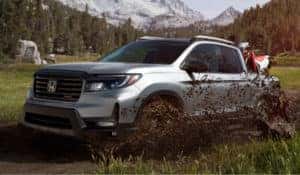
Image via automobiles.honda.com
AWD is a system that powers your front and rear wheels at all times. AWD systems help distribute power to all the wheels to continually optimize your vehicle’s traction, regardless of road conditions. But AWD systems also operate smoothly under normal conditions.
There are two kinds of AWD systems — all-time or full-time AWD and part-time or automatic AWD. Both AWD systems operate without driver input, so you don’t need to worry about turning on or engaging your AWD system. Although, some vehicles do offer selectable modes that give you a measure of control over what power goes where.
All-time and full-time AWD power all four wheels continuously. No matter the weather or road conditions, your vehicle’s AWD system is continually engaged. Conversely, part-time or automatic AWD only uses AWD when necessary. So, most of the time, your system is in two-wheel drive mode. But when better traction is needed, your vehicle — using electronic sensors — will automatically switch to AWD. This function can help conserve fuel and deliver superior efficiency compared with full-time AWD.
Advantages and Disadvantages of AWD
The main advantage of AWD is that you typically don’t have to consciously decide to physically engage your AWD system. Most AWD systems automatically turn on when your vehicle senses a loss of traction and send power to where it’s needed most. Another advantage of AWD is that it’s available in various vehicles, not just in trucks and large SUVs. This means you can choose from a large swath of AWD-equipped vehicles.
One potential disadvantage to AWD is that serious off-roading experts and enthusiasts consider it a lesser system than 4WD. Similarly, AWD typically increases the cost of your vehicle and will, conversely, decrease its fuel economy.
4WD
Trucks and large SUVs are usually the vehicles that house 4WD systems, and this drivetrain system is the more established of the two. Unlike newer AWD systems, drivers generally manually operate 4WD through a mechanical connection, traditionally through a floor-mounted lever. So, while 4WD has evolved over the years, you’ll typically still need to press a button or knob to activate your vehicle’s 4WD system.
Like AWD, most vehicles design their 4WD to maximize your vehicle’s traction in the front and rear wheels. Still, 4WD systems are typically more robust, as they send a fixed amount of power to each tire. Whichever tire needs the most traction is guaranteed to receive the necessary power to prevent your vehicle from getting stuck.
Like AWD, there are full-time and part-time 4WD systems. Full-time 4WD is similar to full-time AWD systems, with your vehicle’s 4WD always engaged, no matter the conditions. However, some models allow you to control how you allocate this power. With part-time 4WD, your vehicle generally operates by two wheels — usually the rear two. You engage your vehicle’s 4WD when you need additional traction by pushing a button or shifting a lever.
Advantages and Disadvantages of 4WD
4WD’s primary edge lies in its superior handling in unfavorable conditions, both on- and off-road. Because 4WD delivers a fixed amount of power to each wheel, it can better handle low-traction environments. Those who frequently work or play in rugged terrain will likely find 4WD best suits their needs.
Conversely, 4WD is often coupled with a suitably heavy-duty suspension, depending on the make and model of your vehicle. As a result, your vehicle may feel stiffer than a 2WD or AWD vehicle. And as with AWD, 4WD can increase your vehicle’s initial cost while decreasing fuel efficiency.
AWD vs. 4WD in Inclement Weather
Regardless of which drivetrain you choose, it’s vital to note that neither can guarantee your vehicle won’t slip or skip in rainy or snowy conditions. Still, both systems can help keep you safe in inclement weather. Which one will work best depends on the conditions you expect to encounter.
Road conditions are more likely to change quicker in colder climates with hard-packed snow or ice. Because of this variability, AWD is likely best suited for your needs. AWD, which automatically engages four-wheel torque, is best in these conditions, as these systems can engage quicker than most drivers can manually.
However, if you live in a climate with deep snow and more extreme conditions, 4WD is best, as it provides better traction on icy hills or in significant snow drifts. In such severe conditions, 4WD will help keep you from getting stuck better than AWD.
The Final Score
Ultimately, the drivetrain system you choose should depend on where you live and the road conditions you expect to face. If you want diversity in the type of vehicle you select, AWD is likely best. Today, numerous trucks, SUVs, and cars come equipped with AWD. Additionally, if you expect to drive on roads primarily, AWD is likely best, as this system can handle corners and other sharp turns better than 4WD.
But if you expect to spend a significant amount of time off-road or navigating through extreme on-road conditions, 4WD is likely your best option. In these environments, 4WD excels by sending power to the wheel or wheels with the best traction, which helps prevent your vehicle from getting stranded.
You’ve found the right place if you’re in the market for a new or pre-owned vehicle in the Cincinnati area. At Performance Kings Honda, we have a large variety of AWD and 4WD vehicles. Our excellent finance team will also help you find the best loan or lease that suits your needs. And if you have any questions about which option works best for you, contact us online or give us a call at (513) 793-7777 to learn more or schedule a test drive.
0 comment(s) so far on What’s the Difference Between AWD and 4WD?